
xCellSense®: FUNCTIONAL DRUG-RESPONSE DATA FROM LIVING PATIENT CELLS
xCellSense® measures how primary blood-cancer cells respond to your drug candidate ex vivo—with study-specific capabilities for combination profiling, population-resolved flow cytometry, molecular profiling, and machine-learning analytics using matched aliquots from the same patient specimen.

Keeping primary cells alive

Primary blood-cancer cells are notoriously fragile outside the body. ImpriMed's proprietary Optimum Media preserves the viability and stability of patient-derived cells after biopsy — where conventional media lose them within days.
That viability window is what enables quantitative, reproducible functional testing on real patient cells. It is difficult to replicate — and it is the technical foundation of everything below.
Draw the readouts you need from a single sample

Dose-Response Package
Individual dose-response curves, IC₅₀ / AUC / Eₘₐₓ metrics, and cross-sample statistics.

Drug Combination Package
Multi-drug combinations with quantitative synergy metrics (Bliss, Loewe, ZIP, HSA) and full dose-response data.

Flow Cytometry Package
Gating strategies, population viability, and antigen expression — resolving response in the malignant population.

Genomic & Transcriptomic
Targeted or full NGS — mutation summary, gene list, VAF, DEGs, and predicted impact.

Integration Summary
Responder stratification, biomarker and clinical insights, and inclusion-criteria recommendations.

Extended Analyses
scRNA-seq (UMAP, pathway, cluster markers) and bulk RNA-seq / Methyl-seq integration.
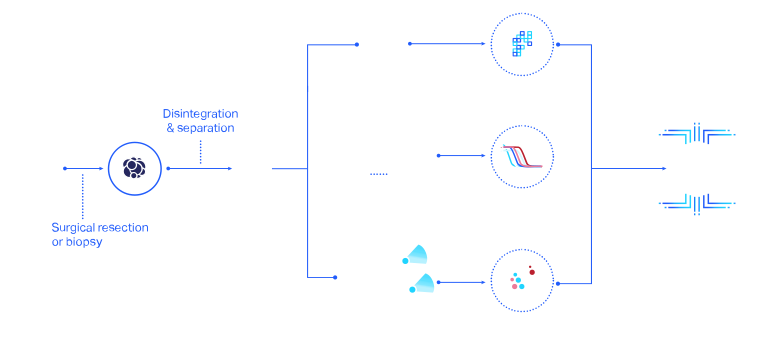
A defined 6-step process
* Every study is custom-designed for your candidates, controls, dose ranges, readouts, and statistical analysis.
A clear, defensible interpretation — not a raw-data dump
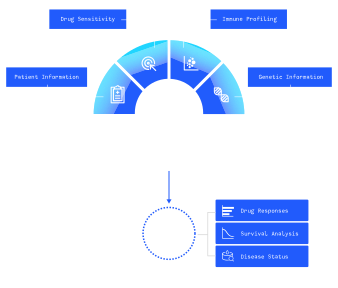
An ML analytics layer scores synergy, classifies response patterns, extracts predictive biomarkers, and stratifies responders from non-responders — transforming multidimensional functional and genomic data into a sponsor-ready interpretation.
Published, not marketed

Ex vivo drug sensitivity testing in Korean AML patients: Integration of functional and genomic profiles for predicting clinical response and survival
Quantitative ex vivo synergy profiling uncovers heterogeneous combination responses in AML primary samples

Quantitative ex vivo assessment of chemotherapy synergy using patient-derived non-Hodgkin lymphoma samples
Quantitative ex vivo synergy profiling uncovers heterogeneous combination responses in acute myeloid leukemia

Predicting Chemotherapy Response in Patients With Advanced or Metastatic Pancreatic Cancer Using Machine Learning

ML-based sequential analysis to assist selection between VMP and RD for newly diagnosed multiple myeloma
Discuss how xCellSense® applies to your program
A scientist — not a sales desk — will scope a tailored study on primary patient cells.

Resources
& Links
